

Front Signs vs 3D Printed Signs for Your Space
Last Updated: October 25, 2026
Quick Summary
3D printed signs create dimensional lettering that projects outward, catching light and drawing attention from multiple angles, while traditional 2D signs deliver a flat, single-plane design. 3D printed signs use durable PLA plastic that holds intricate detail and colour vibrancy, resists fading, and outperform flat signs when viewed from angles or in directional lighting.
- 3D printed signs cast shadow lines that add contrast and improve readability, especially when viewed from 45 degrees or from side walls.
- PLA plastic resists cracking, warping and colour fade indoors, with production typically taking 3-5 business days.
- Letter height and viewing distance determine legibility more than depth; a common rule is 25-40 mm of cap height per metre of viewing distance.
- Dimensional signs need load-rated anchors on plasterboard and masonry fixings on brick or concrete.
- Approval from landlords, strata bodies or councils must be obtained in writing before production starts.
Table of Contents
- 2D Signs vs 3D Printed Signs: Key Differences
- Visual Impact and Brand Recognition
- Custom 3D Printed Signs: Materials and Construction
- 3D Sign Materials: What Works Best
- 3D Printed Sign Durability and Weather Resistance
- How to Order a Custom 3D Sign
- Choosing the Right Option for Your Project
- Frequently Asked Questions
2D Signs vs 3D Printed Signs: Key Differences
Traditional 2D signs deliver a flat, single-plane design. 3D printed signs create dimensional lettering that projects outward, catching light and drawing attention from multiple angles.
A 2D sign works where viewers face it directly; a 3D printed sign commands attention in a room, especially when light hits the dimensional surfaces.
Here's what separates them in practical terms: explore related alternatives and comparisons
| Aspect | 2D Signs | 3D Printed Signs |
|---|---|---|
| Visual Depth | Flat surface only | Dimensional lettering and texture |
| Light Interaction | Minimal shadow play | Creates dramatic shadows and highlights |
| Durability | Prone to fading and peeling | Resists fading, holds colour long-term |
| Customisation | Limited to design variations | Unlimited text, themes, and details |
| Installation | Adhesive or basic mounting | Lightweight, multiple mounting options |
| Cost | Generally lower upfront | Higher initial investment |
Visual Impact and Brand Recognition
Dimensional lettering changes how a sign is perceived for mechanical reasons. Understanding them lets you predict whether depth will help in your specific location.
The shadow line is the real advantage
A flat sign communicates through colour and shape alone. A dimensional sign adds a third signal: the shadow cast by the raised edge, a hard contrast boundary that makes dimensional text read sharper than flat print of the same size and colour.
Angled light produces a pronounced shadow on one side of each letter; straight-on light produces almost none.
Depth and recognition
In wayfinding and retail design, people locate dimensional signage faster than flat signage at the same distance, particularly in cluttered environments, the visual system responds strongly to luminance boundaries, and a shadow line supplies one. The advantage shrinks when sign colour is close in luminance to the background, viewing distance is short, or lighting is so even that no shadow forms.
Readability at distance and at angle
Distance. Readability is governed mainly by letter height and contrast. Depth helps at the margin by adding contrast, but cannot compensate for letters too small for the viewing distance.
Angle. This is where dimensional signs genuinely outperform. A flat sign viewed from 45 degrees is foreshortened and harder to parse; a dimensional sign still presents its raised edges, so letterforms retain more shape, a real benefit for side walls, above doorways, or anywhere viewers approach obliquely.
Accessibility considerations
Signage that carries information, room names, directions, instructions, has accessibility obligations decorative signage does not. In Australia, the Disability Discrimination Act 1992, the National Construction Code's access provisions and AS 1428.1 set expectations for signs in public buildings, including character size, contrast, and tactile and braille lettering for certain sign types (Disability (Access to Premises, Buildings) Standards 2010). For decorative home signs, none of this applies. The practical implications:
- Contrast matters more than depth. A high-contrast flat sign beats a low-contrast dimensional sign for accessibility every time.
- Tactile requirements favour fabricated dimensional lettering, but only if it meets specified height, spacing and finish requirements. A 3D-printed decorative sign is not automatically compliant tactile signage.
- Gloss finishes create glare that reduces legibility for people with low vision; matte finishes are generally safer for information-bearing signs.
If the sign conveys information the public needs, check the applicable access standard before choosing a format.
Brand consistency across a space
Where a sign is one of several, recognition depends on consistency as much as depth. A common pattern is dimensional lettering for the primary identifier, name, logo, room label, and flat print for secondary information such as hours or small print, keeping the visual hierarchy clear.
What depth does not fix
Depth does not fix a poor colour choice, an illegible typeface, letters too small for the distance, or a sign placed where nobody looks. The most common disappointment with dimensional signage comes from expecting the third dimension to compensate for a design already weak in two.
Custom 3D Printed Signs: Materials and Construction
Customisation happens before printing: you choose your text, colours and design elements, and the printer creates exactly what you've specified, not a template variation.
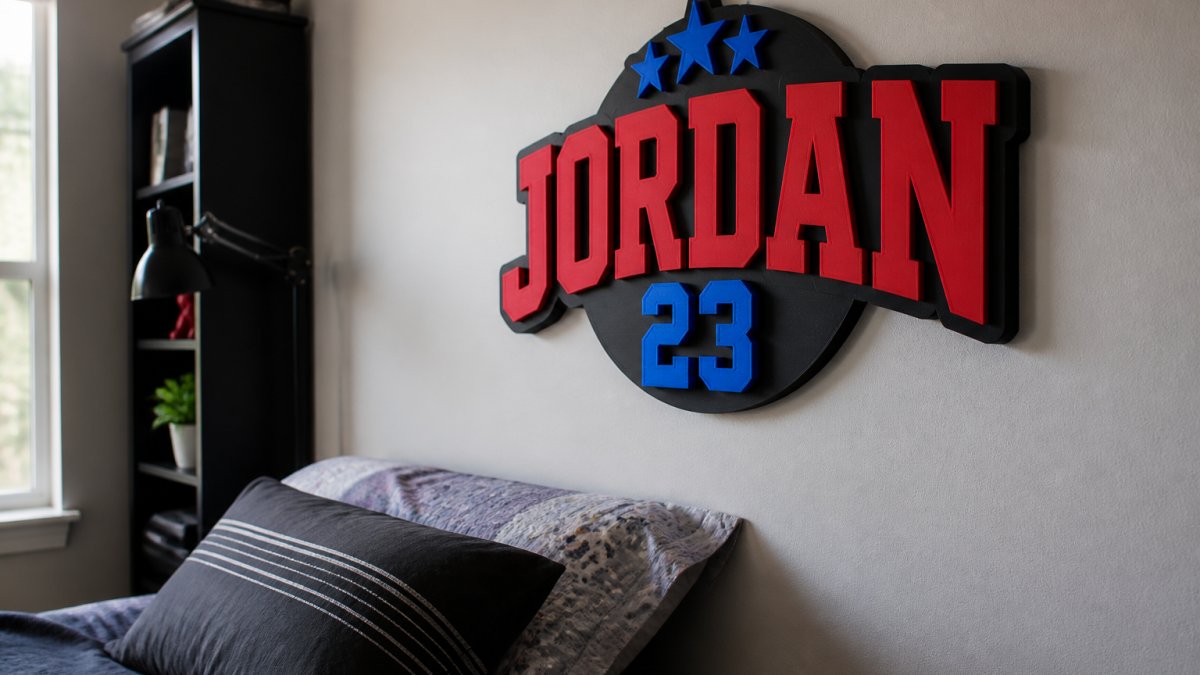
Most custom orders require 3-5 business days for production.
Quality varies with printer settings and material quality. A well-executed 3D printed sign has smooth surfaces, vibrant colours and clean detail; minor layer lines are normal and don't indicate a defect.
3D Sign Materials: What Works Best
PLA plastic dominates the 3D printing market because it's affordable, durable and easy to work with, holding colour well and providing the structural integrity needed for dimensional lettering.
Colour retention depends on material quality: PLA holds vibrant colours. Surface finish matters too, smooth looks polished and cleans easily.
3D Printed Sign Durability and Weather Resistance
Indoor 3D printed signs are highly durable: PLA resists cracking, warping and colour fade in typical room conditions, and temperature fluctuations in heated or air-conditioned spaces don't damage it. Outdoors is where they have limitations, extended UV exposure fades colours and moisture and temperature swings affect the material, so outdoor placement needs UV-protective coatings or acceptance of gradual fading.
Humidity affects PLA less than many assume, but prolonged wet conditions will eventually cause issues, so keep bathroom signs out of direct splash zones. Impact resistance is moderate, a sign won't shatter like glass but can crack if struck hard, which is why secure mounting matters.
Custom 3D Printed Sesame Street-Style Light Pole And Sign – Personalized Name →
How to Order a Custom 3D Sign
Ordering a custom 3D printed sign is straightforward. Start by choosing your design, whether a themed sign (Minecraft, Sesame Street, Spider-Man, Cars-inspired) or a simple nameplate. Most providers, including Wiggle N Click Prints, let you personalise with specific names and numbers, and the preview step catches spelling errors.
Once confirmed, production typically takes 3-5 business days as the printer builds your sign layer by layer. Quality providers pack carefully because signs can be fragile in transit, and some ship in separate pieces with assembly instructions included. Most providers offer standard shipping within 1-2 weeks of production completion. On arrival, inspect for damage and verify it matches your order.
Browse personalised signs to see the range of options available, from themed designs to custom nameplate styles.
Choosing the Right Option for Your Project
Most buying guides stop at "2D is cheaper, 3D looks better." Learn how custom signs work in specific spaces like kids' rooms The useful question is narrower: given your location, viewing distance, lighting, mounting surface and budget, which format actually performs? Work through the criteria below in order, the first two usually settle the choice.
1. Start with viewing distance and letter height
Legibility is governed by the ratio of letter height to viewing distance, not by whether the sign is flat or dimensional. A common rule of thumb for indoor signage is roughly 25-40 mm of cap height per metre of viewing distance, higher where contrast is poor or viewers are moving:
- A nameplate read from 1-2 m needs letters around 40-80 mm tall.
- A sign above a doorway read from 4-5 m needs letters around 120-200 mm tall.
- A sign viewed from 10 m or more needs 300 mm-plus letters, pushing you toward a fabricated panel rather than a printed plaque.
Dimensional lettering buys a little tolerance because the shadow line adds contrast, but it does not repeal the ratio. If letter height is marginal, increase the size or move the sign closer.
2. Match the format to the lighting
Light is where 2D and 3D diverge most in practice.
- Flat 2D prints rely on the artwork's own contrast: clean under even, diffuse light, but prone to wash-out or glare under strong directional light.
- Dimensional 3D signs gain from directional light because raised edges cast a shadow line that sharpens the letterform, though the same shadow can obscure fine detail at a shallow angle.
In a dim corridor, stairwell or side-lit room, dimensional lettering usually outperforms flat print. In a brightly and evenly lit space, the advantage narrows and the decision shifts to budget and finish.
3. Check the mounting surface before you commit
Depth adds stand-off, and stand-off changes what fixing you need.
- Plasterboard or rendered walls suit lightweight printed signs fixed with adhesive strips or small screws into studs; heavier dimensional signs need load-rated anchors.
- Brick, concrete and tile need masonry fixings; adhesive alone is unreliable.
- Glass and metal need non-marking fixings, with care on glass with any adhesive that could leave residue.
Measure the wall, confirm what is behind it, and size the sign to the fixing you can achieve. A sign too heavy for its mounting is a safety issue.
4. Establish whether approval is required
This is the step most guides skip, and the one that most often derails a project.
- Indoor signs in a home generally need no approval, but renters should check the lease, many tenancy agreements restrict fixings that penetrate walls.
- Strata and apartment buildings usually require owners corporation approval before any sign is affixed to common property or visible from outside.
- Commercial premises are governed by local council planning and signage rules, which vary by jurisdiction and commonly regulate size, illumination, projection over footpaths and heritage overlays.
Get any approval in writing before production starts. A sign that has to be removed after installation is a total loss.
5. Understand what drives the quote
Quotes for custom signs are not comparable unless the scope matches. The variables that move price most are:
- Physical size and letter count, material use scales with area and complexity.
- Design complexity, fine detail, multiple colours and small counters take longer and are more prone to failure.
- Material and finish, standard versus premium filament, matte versus gloss, single versus multi-colour.
Ask each supplier to itemise these variables. A lower headline figure often reflects thinner material, less infill, or supply-only pricing.
6. Weigh upfront cost against replacement cycle
A flat printed sign is usually the lower upfront cost; a dimensional sign the higher. The comparison only becomes meaningful when you divide by expected service life.
- Indoors, in a stable temperature-controlled room away from direct sun, a well-made dimensional sign should last many years with only dusting.
- A flat print in the same location may discolour or lift at the edges sooner, particularly if paper-based or using low-grade adhesive.
- Outdoors, neither format is maintenance-free: UV exposure fades colour and moisture stresses fixings, so the practical answer is usually a purpose-made exterior sign.
If the sign is temporary, the flat option wins on cost. If it is permanent, the dimensional option usually wins on cost per year of service.
7. A short decision sequence
- Measure the viewing distance and set the minimum letter height.
- Note the light direction and intensity at the sign's location.
- Identify the wall substrate and the fixings it will accept.
- Confirm whether landlord, strata, council or centre approval is needed, and get it in writing.
- Get itemised quotes on the same scope.
- Compare cost per expected year of service, not headline price.
Worked through in that order, the choice usually becomes obvious before you reach the quote stage, and you avoid the most common failure mode: a sign that is beautiful, correctly priced, and impossible to mount or approve.
Frequently Asked Questions
What is the difference between 2D and 3D printed signs?
2D signs are flat designs printed or painted on a surface, offering limited depth perception. 3D printed signs feature dimensional lettering and layered elements that create visual depth and stand out more prominently. 3D printed signs typically offer greater visual impact and brand recognition because the dimensional appearance draws the eye and creates a more memorable impression in any space.
Are 3D printed signs durable enough for outdoor use?
3D printed signs made from quality PLA plastic offer good durability for most indoor applications and sheltered outdoor areas. For full outdoor exposure with harsh weather, durability depends on the material quality, finish, and protective measures. Check with your provider about specific outdoor suitability for your climate.
How long does it take to receive a custom 3D printed sign?
Most custom 3D printed signs take 3-5 business days for production, with additional time for shipping depending on your location. The timeline accounts for design preparation, printing, quality checks, and careful packaging. When ordering for a specific date, factor in both production and delivery time to ensure your sign arrives when needed.
What materials are commonly used for 3D printed signs?
PLA plastic is the most common material for 3D printed signs because it is durable, lightweight, and available in vibrant colours. PLA offers good strength for indoor displays and sheltered outdoor use. The material choice affects the sign's finish, flexibility, and how well it resists weather and UV exposure over time.
Custom 3D printed signs deliver dimensional depth, durability, and personalisation that flat alternatives can't match. At Wiggle N Click Prints, we specialise in bespoke signs with customisable names and numbers, plus themed designs for popular franchises. Browse our collection of personalised signs to find the perfect option for your space, and get started with a custom order that brings your vision to life.
