

3D Print Alternatives: What to Compare
Table of Contents
- Why 3D Print Alternatives Matter
- Understanding Custom 3D Printing Services
- 3D Printing Materials: How to Choose
- Comparing Quality and Durability
- Personalised 3D-Printed Gifts: What to Expect
- Design Options and Free 3D Design Software
- Common Mistakes When Ordering Custom 3D Prints
- Frequently Asked Questions
Last Updated: October 16, 2026
Why 3D Print Alternatives Matter
The difference between a great finished product and a disappointing one often comes down to choosing the right service.
Not every 3D printing service delivers the same quality, materials, or turnaround times. Some specialise in rapid prototyping, others in hobby-grade prints, and a few, like us, in custom personalised items and themed merchandise.
This guide walks you through what to compare when evaluating custom 3D print alternatives, so you can choose a service that matches what you actually need.
Understanding Custom 3D Printing Services
A custom 3D printing service takes your design or idea and produces a physical object using additive manufacturing. Unlike mass production, each print is made individually, so your item can be tailored to your exact specifications. The process starts with a digital design, usually an STL file; the service prepares that file, selects materials, and runs the print, ready for finishing touches like painting or sanding.
What makes one service different from another
The core differences between 3D printing suppliers come down to a few factors. Material choice: some offer only standard PLA, whilst others stock a wider range of materials. Design flexibility: some have template libraries, whilst others accept fully custom designs. Quality consistency matters enormously: well-maintained equipment and experienced operators produce cleaner prints. Turnaround varies, and finishing ranges from raw prints to various add-ons.
3D Printing Materials: How to Choose
Most guides list filament types and stop there. You are buying an outcome, and the material is the biggest lever on whether that outcome survives real life. Here is how to choose, framed around what you are ordering.
Match the material to the item, not the other way around
| What you are ordering | Sensible material | Why | Watch out for |
|---|---|---|---|
| Name signs, display plaques, shelf decor | PLA | Crisp detail, wide colour range, low cost | Warps in a hot car or direct summer sun |
| Keychains, bag tags, handled collectibles | PETG or tough PLA | Survives drops and constant pocket wear | Slightly less crisp fine detail than standard PLA |
| Outdoor ornaments, letterbox numbers | ASA or ABS | UV and heat resistance | Needs post-processing for a clean finish |
| Functional clips, brackets, moving parts | Polycarbonate or nylon | High impact and fatigue resistance | Higher cost, fewer suppliers stock it |
| Eco-conscious gifts | Recycled PLA or rPET | Lower virgin-plastic content | Colour range is narrower and stock fluctuates |
The questions that actually separate suppliers
A supplier's material list tells you very little. These five questions tell you almost everything:
- Which materials do you hold in stock right now? A long list with nothing on the shelf means a two-week wait while they reorder.
- What is your default layer height? Around 0.2 mm is standard. Suppliers offering 0.12 mm or finer for display pieces are signalling that they care about surface finish.
- What infill do you use for handled items? Decorative pieces at 10-15% are fine. Anything a child will carry should be 20% or higher.
- Do you print in the colour shown, or paint it? Printed-in-colour is more durable. Painted finishes look smoother but chip at edges.
- Can you supply a material data sheet? Reputable suppliers can. If they cannot name the brand of filament they use, that is a signal.
If you are ordering a gift for a child, it's wise to consider the material's properties.
Where the cost actually sits
Material choice can influence the price. Finishing, such as sanding, priming, or painting, is often quoted separately and can add to the cost on small items. A supplier quoting a single flat rate regardless of material is either absorbing the difference or using the cheapest option across the board. It's always a good idea to ask about pricing structures.
What to do when the supplier does not stock your first choice
This is the most common friction point. You want PETG, the supplier only runs PLA. Three options:
- Ask for a thicker-walled print in PLA. A 3 mm wall in PLA often outperforms a 1.5 mm wall in PETG for the same item.
- Ask for a different supplier.
- Change the item, not the material. A keychain that lives in a pocket is a different brief to a keychain that hangs on a wall. Match the item to what is available.
A note on eco-friendly options
Recycled PLA and rPET are genuinely better than virgin plastic, but the print is only part of the footprint. Shipping distance, packaging, and whether the item lasts more than a year matter more than the filament label. If sustainability is your priority, ask where the filament is sourced and whether they ship plastic-free.
Comparing Quality and Durability
Photos lie. A supplier's gallery is curated, lit, and shot from the best angle. The print you receive is judged in your hand, in daylight, after a month of use. Here is a repeatable way to compare suppliers.
The five-point quality check
Ask any supplier you are considering for a short video of a finished item, not a photo, rotating slowly under natural light. Then look for these five things:
- Layer lines. Faint, even striations are normal. Deep, uneven ridges suggest a poorly calibrated machine or a rushed print.
- Stringing. Fine wisps of filament between separate parts. A few are acceptable on complex shapes; a lot means the retraction settings are wrong.
- Corner sharpness. Crisp corners and clean edges indicate good temperature control. Rounded, blobby corners indicate overheating.
- Support scars. Where removable supports touched the print, there should be minimal marking. Heavy scarring means the supplier is not finishing their work.
- Colour consistency. On multi-colour prints, the boundaries between colours should be clean.
A supplier who sends a video without being asked is almost always a supplier worth shortlisting. It signals they are proud of the output and confident it will survive scrutiny.
Durability: what actually breaks a 3D print
Most 3D-printed items fail for one of four reasons:
- Heat. PLA softens noticeably in a hot car or a sun-facing window. If the item will live anywhere warm, rule this out first.
- Layer adhesion. Prints fail along layer lines, not across them. A supplier running their nozzle too cool produces weak layer bonds even with good filament.
- UV exposure. Standard PLA and PETG yellow and embrittle outdoors. ASA and UV-stabilised materials are the answer for anything permanently outside.
- Impact at a thin point. A keychain that snaps usually snaps at the ring hole. Ask for a reinforced ring or a thicker wall there.
A supplier who can talk through these four failure modes without prompting understands their craft.
Buyer-type decision guide
Different buyers need different things. Use this to filter quickly:
Hobbyists and occasional buyers Prioritise low minimum order quantities and a clear per-item price. Favour suppliers who offer a proof or preview before printing.
Small businesses ordering in batches Prioritise consistency above all else. Ask for two samples from different production runs and compare them side by side. A supplier whose tenth print matches their first is worth more than one whose first print is marginally better. Confirm they can hold a design on file so repeat orders match exactly.
Educators and schools Prioritise durability, non-toxic materials, and documentation on filament composition. Bulk pricing and a predictable lead time matter more than finish quality.
Gift buyers on a deadline Prioritise a supplier who publishes a realistic turnaround and offers tracking. Ask what happens if the item arrives damaged or late.
How to test a new supplier without risking much
Before placing a large order with an unfamiliar supplier, run this three-step test:
- Order one small item in the material and finish you intend to use for the real order.
- Inspect it against the five-point check above and, if relevant, subject it to the failure mode you are most worried about (leave it in the sun, drop it, put it in a hot car).
- Contact their support with a question about the item. How they respond tells you more than the product itself.
Do not judge a supplier on a single bad print. Judge them on how they respond to it. A supplier who replaces a flawed item without argument is a better long-term partner than one whose first print happened to be perfect.
Red flags worth walking away from
- Refusal to send a video or additional photos of a finished item.
None of these are conclusive on their own. Two or more together is a pattern, and a pattern is a reason to look elsewhere.
Personalised 3D-Printed Gifts: What to Expect
Custom 3D-printed gifts are popular because they solve a real problem: finding something unique and personal is hard. A mass-produced department store item feels generic; a 3D-printed nameplate or themed keychain feels intentional.
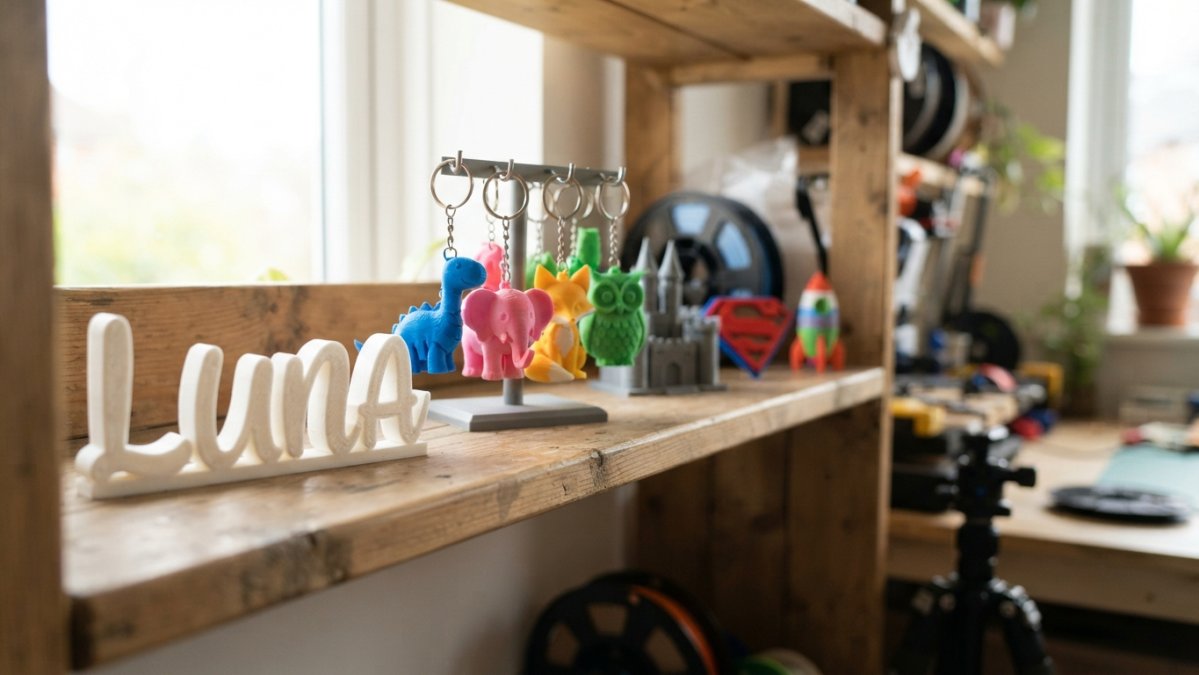
When you order a personalised 3D-printed gift, expect a few things.
Turnaround varies. Rush options exist but usually cost more. Quality should match the photos you saw online, with clean lines and accurate colours.
One thing to prepare for: raw 3D prints sometimes have minor imperfections. Tiny layer lines, small gaps where supports were removed, or slight colour variation are normal. Asking about their finishing process upfront saves disappointment later.
Design Options and Free 3D Design Software
If you have a specific design in mind, you need either a designer or software to build it yourself. Custom design is not always expensive.
Free 3D design software like Tinkercad and Fusion 360 (free for personal use) let you create simple designs without prior experience. Tinkercad is browser-based and intuitive. Fusion 360 is more powerful but has a steeper learning curve. Both export to STL files, the standard format for 3D printing.
If designing yourself feels overwhelming, many 3D printing services offer design consultation. You describe what you want, and they either modify an existing model or create something new.
STL files and model libraries
An STL file is the digital blueprint for your 3D print, describing the object's geometry in a format printers understand. Free STL files are available on sites like Thingiverse and MyMiniFactory, which host thousands of designs ranging from simple shapes to intricate figurines.
If you find a free model you like, download it and send it to your 3D printing service. Many suppliers will print any STL file you provide, and some offer modifications (scaling, adding text, adjusting features). The advantage of existing models is speed and cost; the disadvantage is uniqueness. For truly personalised items, even simple customisation like adding a name makes a real difference.
Common Mistakes When Ordering Custom 3D Prints
Most ordering mistakes fall into a few categories. The first is underestimating lead time: if you need something by a specific date, order early, as suppliers can get backlogged.
The second is vague design briefs.
Third: not checking material compatibility with the intended use. Ordering a PLA outdoor decoration that will sit in the sun for months is a recipe for warping.
Fourth: ignoring finishing options. Raw prints straight off the build plate look noticeably rougher than finished ones. If appearance matters (and for gifts, it usually does), ask about finishing services.
Fifth: assuming all suppliers deliver the same quality. They don't. Check reviews and ask for samples before a large order.
Choosing the right 3D printing service comes down to matching their capabilities to your needs. At Wiggle N Click Prints, we specialise in personalised 3D-printed items, custom name signs, themed merchandise, and animal keychains.
Frequently Asked Questions
What should I compare when choosing a custom 3D printing service?
Focus on material options, print quality and finish, turnaround time, design flexibility, and whether they offer post-processing. Check customer reviews for reliability and ask about their build plate quality and removal process. Services that provide design consultation or free 3D design software support are often more reliable for custom work.
What are the best free 3D design software options for creating custom prints?
Popular free tools include Tinkercad (beginner-friendly, browser-based), Fusion 360 (more advanced), and Blender (professional-grade). Many custom 3D printing services also provide design templates or accept STL files from model libraries like Thingiverse. Choose based on your skill level: Tinkercad for beginners, Fusion 360 for intermediate users, Blender for complex designs.
How do I know if a 3D print will actually be durable enough for everyday use?
Durability depends on material choice and print quality. Ask the service about their layer adhesion, infill density, and whether they use quality printing equipment. Request examples of similar items they've produced, and check if they offer post-processing to improve strength.
Can I request specific names or numbers on a 3D-printed sign?
Yes, most custom 3D printing services offer personalisation options including names, numbers, and custom text. When ordering, provide clear specifications: font preference, size, placement, and any design details. Services that offer design consultation can help you visualise the final result before printing begins, reducing the risk of disappointment.