

Why Custom 3D Printed Gifts Cost More
Table of Contents
- Why Custom 3D Printed Gifts Cost More: The Real Breakdown
- The Main 3D Printing Cost Factors That Drive Up Price
- Custom 3D Print Design Cost: Why Personalisation Adds Expense
- 3D Printing Materials and Cost: What You're Actually Paying For
- How to Reduce 3D Printing Costs Without Sacrificing Quality
- When Custom 3D Printing Makes Financial Sense
- Conclusion
- Frequently Asked Questions
Last Updated: October 14, 2026
Why Custom 3D Printed Gifts Cost More: The Real Breakdown
Custom 3D printed items often cost more than mass-produced alternatives. At Wiggle N Click Prints, understanding why custom 3D printed gifts cost more helps customers decide whether the investment makes sense.
The reason isn't complicated: custom 3D printing involves labour, materials and equipment time that factory production doesn't. Each item is made specifically for you, so setup, design and finishing all factor into the price.

The Main 3D Printing Cost Factors That Drive Up Price
Custom 3D printing isn't a single process with one cost, several factors stack on top of each other.

Where a Custom Gift Quote Actually Comes From
A transparent quote for a one-off personalised gift typically breaks into five buckets, even if studios don't show you the split:
- Design and file preparation, turning your idea, name or logo into a printable model, or adapting an existing template.
- Material, the filament or resin consumed, plus a waste allowance for supports and failed starts.
- Machine time, the hours the printer is tied up, including electricity, nozzle and bed wear, and the opportunity cost of that machine not running another job.
- Post-processing and finishing, support removal, sanding, painting, sealing and any assembly.
A useful rule of thumb: material is often the smallest line, commonly around 10-20% of the final price for a typical PLA gift, while machine time and labour make up the bulk. That's the opposite of what most buyers assume.
Machine Time and Production Volume
Machine time is usually the largest single driver. A printer runs continuously while your item prints, consuming electricity and wearing down equipment, and larger or more detailed items take longer.
A factory making 10,000 identical keychains spreads tooling and setup across thousands of items.
Print time varies based on:
- Item size and complexity
- Layer height and print speed settings
- Material type (some materials print faster than others)
- Whether the design requires support structures that need removing later
A small personalised keychain might take 2-4 hours to print; a larger custom sign could take 8-12 hours or more. That machine time is a real cost passed to you.
Why One-Off Items Cost More Per Unit Than Batch Orders
Design and setup is a fixed cost, it happens once regardless of quantity, so the more units you spread it across, the lower the per-unit price.
| Order quantity | Design/setup share | Machine time share | Typical per-unit pattern |
|---|---|---|---|
| 1 unit | Full cost on one item | Full cost on one item | Highest per-unit price |
| 5 identical units | Split five ways | Split five ways | Noticeably lower |
| 20 identical units | Split twenty ways | Split twenty ways | Lowest per-unit price |
The pattern holds even when per-unit material cost stays roughly the same, because material is a small slice of the total. A single bespoke gift always looks expensive next to a run of identical personalised items.
Setup and Labour
Before any printing happens, someone prepares your design: reviewing requirements (names, colours, details), preparing the 3D model, checking it will work on the printer, and setting up the right settings for your material.
This labour isn't free. Even adding a name to a sign requires editing the file, testing it and confirming it prints correctly. More complex designs take longer and cost more.
Quality control adds another layer: after printing, items need inspection, and defects, a print failing mid-way, a layer not adhering, are built into pricing.
How Complexity and Print Failure Risk Add Cost
Complexity adds risk as well as print time, and risk is priced in. Several design choices raise the cost of a custom gift:
- Support structures. Overhangs and steep angles need temporary supports that are printed, then removed by hand. That's extra material and extra labour, and removal can mark the surface.
- Fine details and thin walls. Very fine features are more likely to fail or print inconsistently, so a maker may need to slow the printer down or reprint.
- Tolerances. Parts that must fit together (a lid, a moving joint, interlocking pieces) need tighter settings and often a test print.
- Orientation. The same model can take very different times and support needs depending on how it's placed on the bed. A good orientation can cut both time and waste.
A simple, chunky, single-colour design with no overhangs is the cheapest to print reliably; an intricate, multi-part, fine-detail piece is the most expensive.
Custom 3D Print Design Cost: Why Personalisation Adds Expense
When you order a custom 3D printed gift, you're paying for design work, not just material and machine time.
A template design (like a standard Minecraft-style sign) already exists, so costs are lower.
Design costs include:
- Initial consultation to understand what you want
- Creating or modifying the 3D model
- Testing the design to ensure it prints without problems
- Adjustments if the first version doesn't work
A simple personalisation (adding a name) might take 15-30 minutes; a fully custom design could take several hours.
This is also why one-off custom items cost more per unit than batch orders: with five identical personalised signs, the design work is done once and spread across five items.
3D Printing Materials and Cost: What You're Actually Paying For
Material is only part of the cost equation, but your choice affects how the gift looks, how long it lasts and how it should be handled.
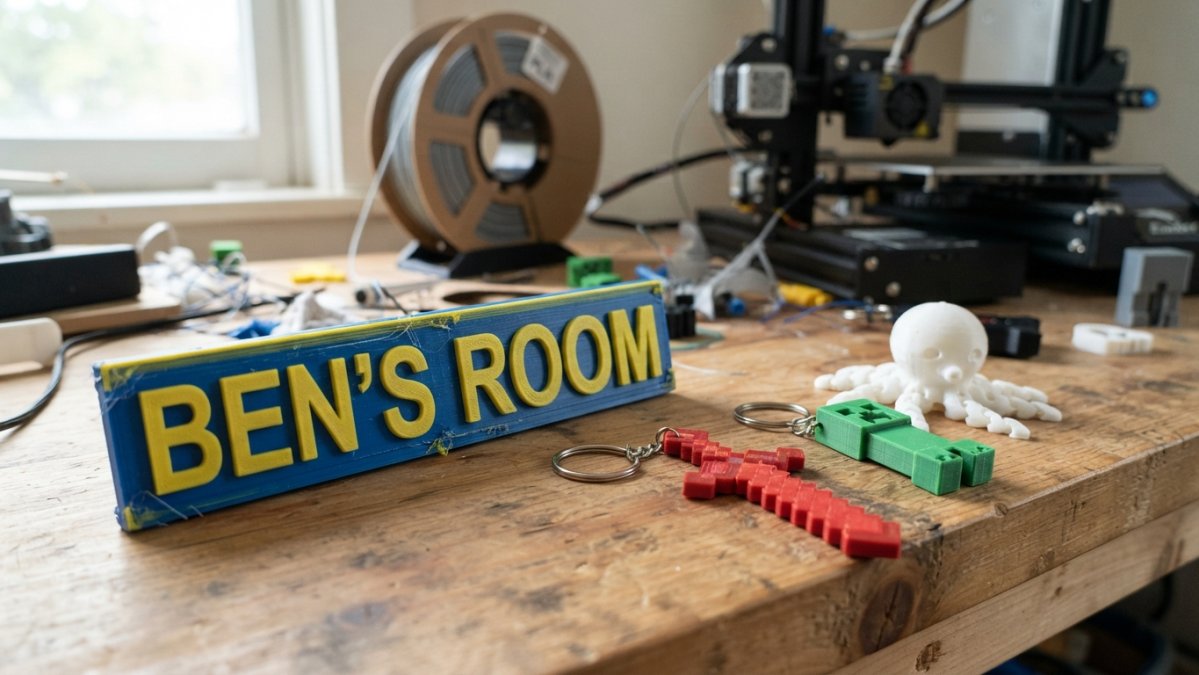
Material Selection and Quality
Most custom 3D printed gifts use PLA (polylactic acid), a durable, affordable plastic. Material costs vary by type (PLA, ABS, resin, specialty), colour and finish, weight used, and waste from failed prints or supports.
Custom 3d Printed Spider-Man Sign →
Higher-quality materials cost more but look better and last longer. Material is usually a small share of the final price, commonly around 10-20% for a typical PLA gift, with the rest covering machine time, labour and overhead.
Material and Finish Trade-Offs for Gifts
Rather than treating materials as interchangeable, match them to the recipient and the job the gift has to do:
| Material | Look and feel | Durability | Cost band | Best suited to |
|---|---|---|---|---|
| PLA | Smooth, matte, wide colour range | Good indoors; softens in a hot car or direct sun | Lowest | Display pieces, nameplates, keychains, decorative signs |
| PETG | Slightly glossier, tougher | Better impact and heat resistance than PLA | Low-mid | Items likely to be handled or dropped |
| ABS | Functional, slightly duller finish | Strong and heat-resistant; can warp during printing | Mid | Practical, hard-wearing items |
| Resin | Very fine detail, smooth surface | Can be brittle; needs careful handling | Mid-high | Intricate figurines and high-detail keepsakes |
| Specialty/wood-fill or metallic-look | Textured, unusual appearance | Varies; often decorative rather than structural | Higher | Statement pieces where appearance is the point |
A few practical notes that don't show up in most guides:
- PLA is the safe default for gifts. It's the cheapest to print reliably, comes in the widest colour range, and looks clean. Its main weakness is heat, a PLA ornament left on a sunny dashboard can soften and deform.
- Resin wins on detail, loses on toughness. If the gift is a finely detailed figurine that will sit on a shelf, resin gives the sharpest result. If it will be handled by a child, resin's brittleness is a drawback.
- Colour can be built in or painted on. Printing in the final colour avoids painting labour, but limits you to available filament colours. Painting gives unlimited colour but adds finishing time and cost.
Post-Processing and Finishing
Raw 3D prints don't always look finished. Post-processing, the work done after printing, affects both cost and quality.
Common steps include:
- Removing support structures (temporary plastic holding overhangs)
- Sanding to smooth rough surfaces
- Painting or staining for colour and protection
- Sealing or coating for durability
A simple item might just need support removal; a detailed gift could require sanding, painting and sealing, adding hours of labour.
This is where quality shows. Carefully finished items look professional and last longer; minimal finishing costs less but may look rough or feel fragile.
How to Reduce 3D Printing Costs Without Sacrificing Quality
If custom 3D printed gifts fit your budget, great. If not, here are practical ways to keep costs down:
Choose simpler designs. Detailed items take longer to print and finish. A simple nameplate costs less than an intricate figurine, and fewer colours mean faster printing and easier finishing.
Go with template designs. Wiggle N Click Prints offers ready-made designs like Minecraft-style signs, Sesame Street-themed pieces and animal keychains.

Accept standard finishes. Premium finishes (hand-painting, special coatings, intricate details) add cost.
Plan ahead. Rush orders cost more because they require priority machine time and faster labour.
Stick with standard materials and colours. Specialty materials or custom colour mixing costs extra.
When Custom 3D Printing Makes Financial Sense
Not every gift needs to be 3D printed. Custom 3D printing makes sense when:
- You want something truly personalised that you can't buy off the shelf
- The recipient values uniqueness and thoughtfulness over cost
- You're ordering multiple identical items (bringing per-unit costs down)
- The item serves a practical purpose (a nameplate for a child's room, a branded keychain for a business)
It doesn't make financial sense if:
- You need the item urgently and rush fees apply
- You're buying a one-off novelty the recipient might not use
- A mass-produced alternative would work just as well
- Your budget is very tight and you need the cheapest option
For many people, the value of a personalised, custom-made gift justifies the higher cost. A child's nameplate sign or a pet-themed keychain is something you can't get anywhere else.
Conclusion
Custom 3D printed gifts cost more because each item is made specifically for you. Machine time, design work, labour, and finishing all add up. Understanding these costs helps you decide whether simpler designs or template options might work better.
If you're looking for personalised gifts that balance quality and cost, Wiggle N Click Prints offers ready-made designs like custom Minecraft signs, Sesame Street-themed pieces, and animal keychains, all with personalisation options like custom names and numbers. These template designs skip the expensive custom design work while keeping that thoughtful, one-of-a-kind feel. Get started with Wiggle N Click Prints and create a gift that's truly personal without breaking your budget.
Frequently Asked Questions
Why do custom 3D printed gifts cost more than standard mass-produced gifts?
Custom 3D printed gifts are made specifically for you, which means no bulk manufacturing savings. Each item requires individual design work, machine setup, and print time. Mass-produced items spread tooling and labour costs across thousands of units; a custom gift bears those costs alone. You're paying for personalisation, quality materials, and skilled production, not factory-scale economies.
What are the main 3D printing cost factors that affect the final price?
The biggest factors are machine time (how long the printer runs), material used (filament weight and type), design complexity, labour for setup and post-processing, and production volume. One-off items cost more per unit because there's no batch discount. Intricate designs take longer to print and may have higher failure risk, which increases the effective cost. Finishing work like sanding or painting adds labour time as well.
How can I reduce the cost of a custom 3D printed gift?
Simplify the design where possible, fewer details mean faster print times and lower material costs. Choose standard colours over custom finishes. Order multiple items at once to spread setup costs. Select materials based on durability needs rather than premium options. Ask whether assembly is required; some items cost less if you assemble them yourself. Longer lead times also often mean lower costs, as the maker can batch orders together.
Is a custom 3D printed gift worth the extra cost?
Yes, if personalisation and uniqueness matter to you. A custom nameplate sign or themed keychain can't be bought off the shelf, it's one-of-a-kind and tailored to the recipient. The cost reflects that exclusivity and the care taken to make it special. For meaningful gifts like nursery decor or hobby-themed items, the personal touch justifies the investment over generic alternatives.